Vous enlevez vos chaussures et c’est là. La marque laissée par vos chaussettes. Des chevilles gonflées. Des jambes qui semblent vous le faire payer depuis le milieu de l’après-midi.
La rétention d’eau fait partie des désagréments les plus courants. Le plus souvent bénigne, parfois signe qu’il faut y prêter attention, elle peut généralement être soulagée grâce à quelques habitudes simples. Ce guide explique ce qu’est la rétention d’eau, pourquoi elle apparaît et ce qui peut réellement faire la différence

Index
Qu'est-ce que la rétention d'eau ?
Le corps humain est composé d'environ 60 % d'eau. Une grande partie se trouve à l'intérieur des cellules et dans les vaisseaux sanguins. Une autre circule entre les tissus, où les veines et le système lymphatique contribuent normalement à maintenir un bon équilibre des fluides.
Lorsque cette circulation ralentit, du liquide peut s'accumuler dans les tissus. Cela se traduit par un gonflement, généralement au niveau des pieds, des chevilles et du bas des jambes. La gravité fait le reste.
Le terme médical est œdème. Dans la vie quotidienne, on parle plus simplement de rétention d'eau, de chevilles gonflées ou de jambes lourdes.
Pourquoi fait-on de la rétention d'eau ?
Les causes possibles sont nombreuses. Voici celles auxquelles la plupart des personnes sont confrontées.
Causes liées au quotidien
- Rester debout ou assis pendant de longues heures. Travail de bureau, métier debout ou vol long-courrier : lorsque les muscles des mollets restent peu actifs, le retour veineux et la circulation des fluides peuvent ralentir.
- La chaleur. Les vaisseaux sanguins se dilatent et davantage de liquide peut s'accumuler dans les tissus. D'où cette sensation de pieds gonflés en été.
- Une alimentation riche en sel. Un apport élevé en sodium peut favoriser la rétention d'eau.
- Le manque de mouvement. Sans activité musculaire régulière, la circulation des fluides ralentit.
Causes hormonales
- Les règles. Les changements hormonaux qui précèdent les menstruations peuvent entraîner une rétention d'eau temporaire.
- La grossesse. L'utérus exerce une pression sur certaines veines et les changements hormonaux favorisent également la rétention de liquides. Les pieds et les chevilles gonflés sont particulièrement fréquents au cours des derniers mois de grossesse.
Causes médicales
- Les varices ou l'insuffisance veineuse. Lorsque les valvules des veines des jambes ne fonctionnent pas correctement, le sang et les fluides peuvent davantage stagner dans le bas des jambes.
- Le lipœdème et le lymphœdème. Ces affections peuvent entraîner une accumulation anormale de tissu graisseux ou de liquide lymphatique.
- Certaines affections cardiaques, rénales ou hépatiques. Elles peuvent provoquer une rétention de liquides dans différentes parties du corps.
- Les effets secondaires de certains médicaments. Certains traitements contre l'hypertension, les anti-inflammatoires ou les traitements hormonaux peuvent favoriser la rétention d'eau.
Un gonflement soudain, une jambe nettement plus gonflée que l'autre, une douleur, un essoufflement ou un gonflement persistant doivent faire l'objet d'un avis médical.
Pour en savoir plus, découvrez également nos guides sur l'œdème, les varices, le lipœdème et le lymphœdème. Si vos jambes sont lourdes ou douloureuses en fin de journée, consultez également notre guide sur les jambes fatiguées.
Comment reconnaître la rétention d'eau ?
Les signes sont généralement faciles à repérer :
- Un gonflement des pieds, des chevilles ou du bas des jambes qui augmente au cours de la journée.
- Des marques laissées par les chaussettes ou les chaussures qui persistent plusieurs minutes.
- Un creux qui reste visible après avoir appuyé avec le pouce sur la peau. On parle alors d'œdème prenant le godet.
- Des chaussures ou des bagues plus serrées le soir que le matin.
- Une sensation de jambes lourdes, tendues ou fatiguées.
- Un gonflement qui diminue pendant la nuit : les jambes sont moins gonflées le matin et davantage en fin de journée.
Que faire contre la rétention d'eau ?
Pour la rétention d'eau liée au quotidien, ces quatre habitudes peuvent faire une réelle différence.
1. Faites bouger vos jambes
Les muscles des mollets jouent un rôle important dans le retour veineux. Chaque pas, coup de pédale ou montée sur la pointe des pieds active les muscles et favorise la circulation dans les jambes.
Trente minutes d'activité modérée par jour peuvent déjà faire une différence sur la sensation de lourdeur en fin de journée. Vous travaillez assis ? Levez-vous régulièrement, faites bouger vos chevilles et profitez-en pour marcher quelques minutes.
2. Surélevez vos jambes
Prenez 15 à 20 minutes pour surélever vos jambes, idéalement au-dessus du niveau du cœur. Cela peut favoriser le retour des fluides et aider à réduire la sensation de gonflement.
Simple, accessible et souvent sous-estimé.
3. Limitez le sel et hydratez-vous suffisamment
Boire davantage lorsque l'on fait de la rétention d'eau peut sembler contre-intuitif. Pourtant, une bonne hydratation contribue au bon fonctionnement des reins et à l'équilibre des fluides dans l'organisme.
Réduire les aliments très transformés peut également aider à limiter les apports excessifs en sodium.
4. Portez des chaussettes de compression
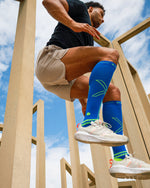
Les chaussettes de compression peuvent aider à limiter l'accumulation de liquide dans le bas des jambes. La pression est plus élevée au niveau de la cheville et diminue progressivement en remontant vers le genou. Cette compression progressive soutient le retour veineux et aide à limiter la sensation de jambes lourdes et de chevilles gonflées.
La différence peut se ressentir rapidement : moins de lourdeur, moins de gonflement et moins de marques laissées par les chaussettes en fin de journée.
Enfilez-les le matin, idéalement avant que le gonflement ne s'installe, puis retirez-les le soir.
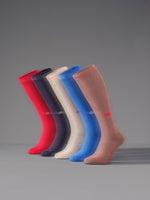
Pour les besoins du quotidien, les chaussettes de maintien STOX offrent un soutien adapté au travail, aux voyages et aux longues journées passées debout ou assis. Si le gonflement est lié à la grossesse, à un métier exercé debout ou à une affection spécifique, découvrez également nos collections dédiées aux chevilles gonflées et à l'œdème.
Dans quelles situations la compression est-elle particulièrement utile ?
Lors des longs voyages
Pendant un long vol, la rétention d'eau est fréquente. Vous restez assis pendant plusieurs heures, bougez peu et l'environnement en cabine peut favoriser la déshydratation.
Les chaussettes de compression peuvent aider à limiter le gonflement des jambes pendant le voyage et soutenir la circulation.
Pendant la grossesse
Les pieds et les chevilles gonflés sont fréquents pendant la grossesse, en particulier à partir du deuxième trimestre. La compression peut aider à soulager cette sensation de gonflement et soutenir les jambes au quotidien.
Pour les métiers exercés debout
Coiffeurs, infirmiers, enseignants ou professionnels de l'hôtellerie-restauration passent souvent de longues heures debout. Dans ces situations, la compression peut apporter un soutien supplémentaire aux jambes tout au long de la journée.
Elle peut également être utile par temps chaud, lorsque la chaleur favorise la sensation de pieds et de chevilles gonflés.
Rétention d'eau : quand consulter un médecin ?
Tous les gonflements ne sont pas anodins. Consultez rapidement un professionnel de santé si :
- Le gonflement apparaît soudainement.
- Une seule jambe est touchée.
- Le gonflement s'accompagne de douleur, de rougeur ou de chaleur.
- Vous ressentez un essoufflement ou une douleur thoracique.
- Le gonflement ne diminue pas après une nuit de sommeil.
- Vous urinez nettement moins ou prenez rapidement du poids sans raison apparente.
Rétention d'eau : en résumé
La rétention d'eau peut avoir de nombreuses causes, mais elle est souvent liée à de longues périodes en position assise ou debout, à la chaleur, au manque de mouvement ou à certains changements hormonaux.
Dans de nombreux cas, faire régulièrement bouger vos jambes, les surélever et porter des chaussettes de compression peut aider à réduire la sensation de jambes lourdes et le gonflement en fin de journée. Si le gonflement apparaît soudainement, persiste ou s'accompagne d'autres symptômes, il est important de consulter un professionnel de santé.
Découvrez toute notre gamme de chaussettes de compression ou apprenez-en plus sur le fonctionnement de la compression STOX.