A fallen arch isn’t automatically a problem. Plenty of people live with one symptom-free. When it does cause trouble, the approach is straightforward: foot muscle training, proper shoes, orthotics when needed, and compression for the knock-on effects. Catching the secondary issues (heel spur, Achilles, knee, back) early is often the biggest win.
Browse our compression socks for heel spur for targeted cushioning or everyday support.

Aching feet by the end of the day. Pain along the inside of your arch. Knee or back issues that don't seem to add up. The origin sits lower than most people expect: your foot arch. Fallen arches (also called flat feet or a collapsed arch) are one of the most common and underrated sources of foot, ankle, knee and back pain.
This guide covers what a fallen arch actually is, how to spot one, when it starts causing trouble, and what helps.
What a fallen arch is
Your foot arch is the natural curve along the inside of your foot, running from heel to ball. It works like a spring: absorbs impact, spreads your bodyweight evenly, and keeps the joints above it happy. When that curve collapses or loses its tension, the whole system has to compensate.
Two main types:
- Flexible flat foot. The arch disappears when you stand, returns when you rise on your toes. The common one.
- Rigid flat foot. The arch is gone even at rest. Usually congenital or anatomical.
There's also the fallen forefoot, where the transverse arch under the ball of the foot collapses. Typical sign: pain under the ball of the foot, often with callus formation.
Why it happens
Fallen arches develop gradually. Usually it's a stack of factors rather than one cause.
Congenital or genetic
- Runs in families
- Connective tissue conditions (hypermobility, Marfan, Ehlers-Danlos)
- Congenital foot abnormalities
Acquired
- Sustained overuse, from long hours of standing or physical work
- Extra bodyweight putting more load on the arch
- Weak foot muscles from too little movement variety and always-closed shoes
- Pregnancy. Hormones loosen connective tissue and added weight loads the arch
- Age. Tendons and connective tissue lose elasticity
- Damage to the tibialis posterior tendon, the arch's main active support
- Inflammatory joint conditions like rheumatoid arthritis
- Diabetes. In some cases this leads to Charcot foot, where the arches collapse
Symptoms
Plenty of people have flat feet without a single complaint. Problems usually start when extra load meets a weak arch, or when the compensation patterns start causing damage upstream:
- A dull ache or sharp pain along the inside of the arch
- Pain under the ball of the foot (for a fallen forefoot)
- Feet tiring faster than expected after standing or walking
- Shoes wearing out faster on the inside
- Swelling along the inside of the ankle
- Calluses or pressure spots in specific places under the foot
- Indirect pain in knees, hips or lower back from altered biomechanics
- More frequent heel spurs, plantar fasciitis or Achilles trouble
A quick check: wet your foot and make a print on a dry floor. A full, wide imprint with no clear arch curve on the inside usually means (relatively) flat feet.
What often comes with it
A fallen arch rarely stands alone. Here's what often shows up with it:
- Heel spur and plantar fasciitis: the plantar fascia gets irritated
- Achilles tendon problems: the altered foot position strains the tendon
- Overpronation: the foot rolls inward on push-off, feeding into knee and hip complaints
- Shin splints: altered loading irritates the shin
- Hallux valgus (bunion): often linked to a fallen forefoot
For more on shin splints and how to prevent them, we've got separate guides.
What helps
1. Train the foot
The muscles holding your arch up can be trained like any other muscle group:
- Towel scrunches. Lay a towel under your foot and grip it toward you with your toes
- Short foot exercise. Lift the arch without moving your toes, like shortening the foot
- Single-leg balance on an uneven surface (cushion, balance board)
- Picking up marbles with your toes
- Walk on toes, then on heels, alternating
Five to ten minutes a day. Results within a few weeks.
2. Orthotics
A properly fitted orthotic from a podiatrist supports the arch passively and redistributes weight. For moderate to severe cases, often the most effective fix. Rule: always pair it with exercises, or your foot muscles will get lazier.
3. Shoes that earn their keep
- Real midfoot support
- A firm heel cup that doesn't pinch
- Toe box with room to spread
- A firm sole that still flexes at the forefoot, not the middle
Flat sneakers, flip-flops and spent running shoes often do more damage than good.
4. Compression and support
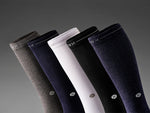
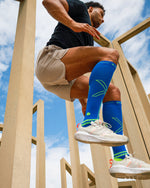
Compression doesn't treat the fallen arch itself. What it does is ease the knock-on effects: tired lower legs, swelling along the inside of the ankle, and pain from overloaded tendons like the Achilles or plantar fascia. For plantar issues specifically, our compression socks for heel spur have cushioning in the right zones. Dealing with shin splints or Achilles tendon trouble on top? We've got targeted socks for those too. For everyday leg support and tired legs, compression socks pick up the slack.
5. Weight and movement
Every kilo multiplies across every step. If you're carrying extra weight, losing some drops the load on the arch meaningfully. Move often, but measured. Huge swings between inactivity and peak loads are a known trigger.
When to see a podiatrist or doctor
- Pain lasting longer than 2 to 3 weeks
- Pain that limits daily activity
- A sudden loss of arch height (can indicate a tendon rupture)
- Increasing swelling along the inside of the ankle
- Limping or knee/hip pain traced back to the feet
- Diabetes and new foot deformities
A podiatrist can do a gait analysis, prescribe custom orthotics and advise on shoes and exercises. A primary care doctor or orthopedic surgeon comes in for anatomical issues or when conservative treatment stalls out.